
When a Belgian Malinois or a German Shepherd enters a high-risk environment, the equipment they wear is every bit as critical as the gear worn by their human handlers. It acts as a protective barrier and a functional tool for operational success.
So, how do you choose the right K9 tactical gear? With countless options flooding the market—ranging from recreational knockoffs to high-end military-spec equipment—making the right call isn’t always obvious.
Choosing subpar equipment can lead to compromised mobility, overheating, or unexpected equipment failure during a critical moment.
To cut through the noise, buyers and procurement officers need to evaluate tactical dog gear based on real-world utility, material strength, and manufacturing standards. Before outfitting a single dog or securing a contract for an entire unit, here are seven vital questions you need to ask.
1. What is the Core Mission of the K9 Unit?

You can’t buy tactical gear in a vacuum. The first step is to pin down the specific role the dog will play, as the operational environment always dictates the required gear profile.
Consider the primary functions your K9 unit performs:
Patrol and Apprehension
If the dog performs bite work and suspect apprehension, the gear needs to be incredibly streamlined. Any excess material or loose straps can be grabbed by a suspect or caught on a chain-link fence during a foot pursuit. You’ll generally want a low-profile vest that doesn’t restrict front shoulder movement, allowing the dog to sprint and lunge.
Search and Rescue (SAR)
Tracking and rescue dogs need lightweight equipment that won’t weigh them down over long distances. High-visibility colors and reflective elements are often prioritized over heavy ballistic protection.
Airborne and Tactical Insertion
If the K9 is used for fast-roping, rappelling, or helicopter insertions, you need a heavy-duty tactical harness designed specifically for load-bearing. These harnesses are built to support the full weight of the animal safely, distributing pressure so it doesn’t compress their chest cavity during a lift.
2. Are the Materials Built for Extreme Environments?
Tactical dogs go where humans often can’t. They crawl under razor wire, push through dense brush, and navigate jagged debris. Standard pet-store nylon will shred under these conditions in a matter of days. When evaluating K9 gear, focus strictly on industrial-grade, military-spec materials.
Look for these non-negotiable material specifications:
1000D Cordura Nylon
This heavy-duty fabric is the industry standard, offering incredibly high resistance to abrasions, tears, and water while remaining relatively lightweight.
Breathable Spacer Mesh
Dogs regulate their body temperature primarily through panting. Wrapping them in thick, non-breathable fabric can quickly trigger heat exhaustion. Quality vests incorporate breathable mesh along the interior lining to promote airflow and dissipate body heat.
Reinforced Stitching
A harness is only as strong as its weakest seam. Require double-bar-tacked stitching using high-tensile nylon or Kevlar thread, especially at high-stress junction points.
Flame Retardance
For specialized military or SWAT operations involving flashbangs or breaching, materials may need to meet specific flame-retardant standards.
3. How Well Does the Gear Accommodate Canine Anatomy?
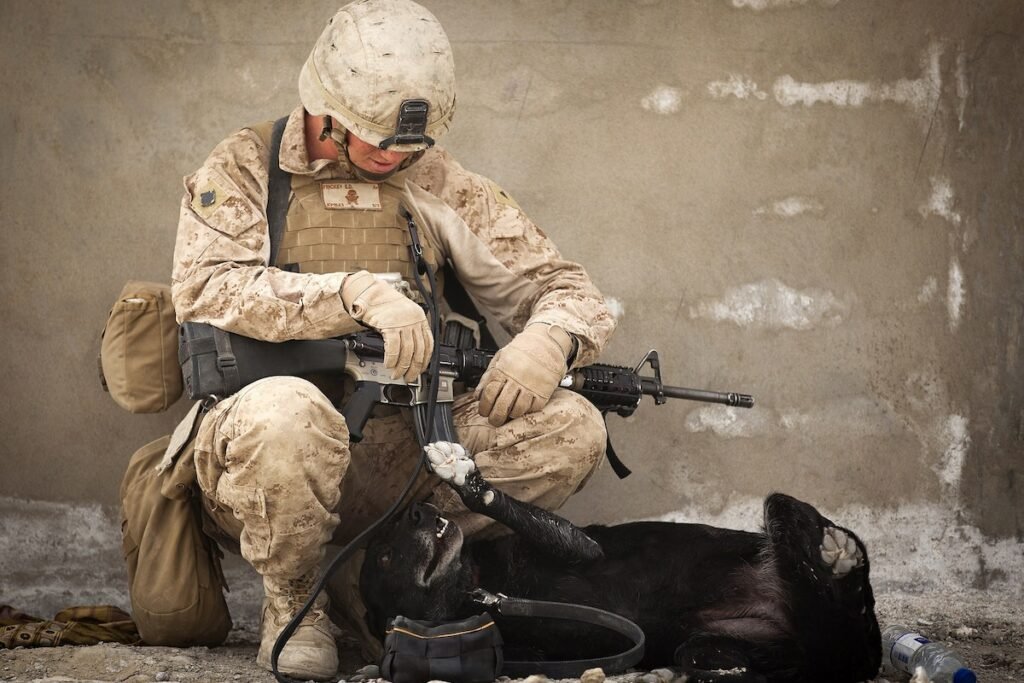
A poorly fitting harness is an operational hazard. If a vest rubs awkwardly behind the dog’s front legs, the animal will instinctively alter its gait to avoid the discomfort. Over time, this biomechanical shift can lead to joint and muscle strain, effectively benching a highly trained asset.
To ensure the gear moves with the dog, prioritize the following fit features:
Unrestricted Shoulders
The design must leave the shoulder blades and front legs completely free to allow for a full range of motion during a sprint or jump.
Multiple Adjustment Points
Dogs carry their weight differently, even within the same breed. A tactical harness needs distinct adjustment straps—typically at the chest, girth, and belly—so it can be tailored to the exact proportions of the specific dog.
Centered Balance
You want a snug, secure fit that stays centered. If the vest sags to one side when a modular pouch is attached, it throws off the dog’s balance and agility.
4. Does the Hardware Support Load-Bearing Operations?
Standard plastic buckles have absolutely no place on professional K9 tactical gear. If a handler is lifting an 80-pound dog over a concrete wall using the handle on their vest, the hardware securing that vest needs to be exceptionally strong.
Inspect the hardware for these critical elements:
Machined Aluminum Alloy Buckles
Often seen in parachuting and fall-protection gear, these mechanisms are designed to withstand hundreds of pounds of force without unclipping or shattering under pressure.
Forged Steel V-Rings
The attachment points for leashes and hoisting should utilize aerospace-grade aluminum or forged steel V-rings integrated directly into the reinforced webbing.
Continuous Webbing Chassis
A D-ring that is simply surface-stitched onto the top layer of fabric is a failure risk. The webbing should run continuously throughout the harness so that when the dog is lifted, the load is safely distributed across the entire strap system.
5. Can the Gear Adapt Through Modularity?
Effective K9 equipment adapts to changing mission requirements. The ability to strip the vest down to a slick, bare-bones profile or scale it up for a complex deployment separates professional tactical gear from standard equipment.
Seek out gear that offers extensive customization options:
MOLLE Webbing
Rows of Modular Lightweight Load-carrying Equipment (MOLLE) along the flanks allow handlers to customize the loadout. Dogs can carry their own lightweight hydration bladders, collapsible bowls, or specialized medical kits during extended missions.
Hook-and-Loop Panels
Large Velcro fields allow for the rapid attachment of unit identification patches (like “POLICE” or “SHERIFF”), as well as infrared (IR) reflective markers or strobe lights for nighttime visibility and friend-or-foe identification.
6. Have You Considered Peripheral Protection?
While the harness is the central component, outfitting a working dog often requires looking at peripheral vulnerabilities—specifically their eyes and paws, which are highly susceptible to environmental damage.
Do not overlook these critical protective accessories:
Tactical K9 Goggles
Dogs deploying in arid environments, urban disaster zones, or near helicopter landing zones face constant hazards from flying debris, sand, and rotor wash. High-impact goggles seal around the dog’s face, protecting against shrapnel and UV rays while preserving a wide field of vision.
Paw Protection
Hot asphalt can severely damage a dog’s pads in minutes. Broken glass, sharp metal, and environmental chemicals present constant ground-level dangers. Tactical dog boots with high-traction, puncture-resistant soles offer vital protection while remaining flexible enough for the dog to maintain tactile ground awareness.
7. Who is Actually Manufacturing the Equipment?
The most frequently overlooked factor in choosing K9 tactical gear is the source of the manufacturing itself. The market is saturated with mass-produced, imported items that look tactical but often fail under real-world stress.
When procuring gear, vet your production partner against these standards:
Strict Dimensional Tolerances
If you are sourcing equipment for government contracts or military use, you need a manufacturer that adheres exactly to engineering blueprints to ensure consistency across the entire production run.
Quality Management Systems (QMS)
You want a partner that operates under a robust, documented QMS to drastically mitigate the risk of defective gear reaching the field.
Domestic Capabilities
Working with a trusted domestic contract manufacturer provides benefits like expert prototype design, proper material sourcing (including Berry Amendment compliance), and shorter supply chains. It also ensures the capacity to scale up production rapidly when a department needs to outfit an entirely new unit.
Find the Right Manufacturing Partner
K9 tactical gear is specialized equipment that requires careful consideration. By prioritizing high-tensile fabrics, ergonomic fits, load-rated hardware, and modularity, you can help ensure that working dogs perform safely and efficiently in challenging environments. Just as importantly, by properly vetting the manufacturing source, you reduce the risk of gear failure in the field.
Don’t compromise on the equipment that outfits your specialized K9 units. If you need high-volume, reliable cut and sew manufacturing for law enforcement and military tactical gear, partner with a team that has the industrial expertise to deliver to your exact specifications.
Contact LCR Services today to discuss your tactical gear manufacturing needs. Email sennsour@lcrsvcs.com or call 602-200-4277.